
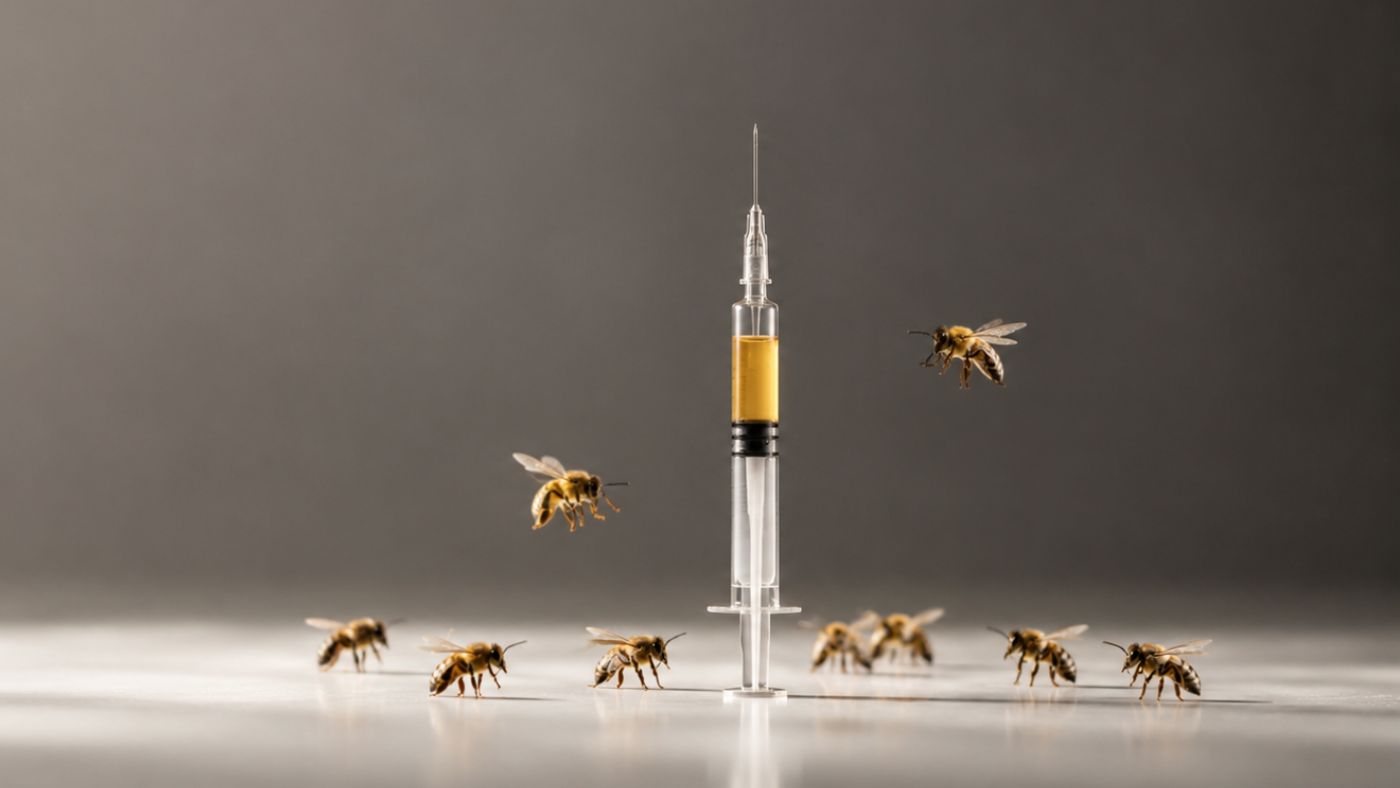

Bee Venom is naturally rich in bioactive peptides, including melittin, apamin and several lesser-known peptides that have been studied for their effects on skin, inflammatory signalling and other biological processes. Unlike many cosmetic peptides that are manufactured and added individually to a formula, Bee Venom contains a naturally occurring mixture of peptides alongside enzymes and other compounds.
Key Highlights
Peptides are short chains of amino acids, the same basic building blocks that form proteins.
The arrangement of those amino acids determines how a peptide behaves. Some peptides work as signalling molecules, while others interact with cell membranes, receptors or enzymes.
That means the word "peptide" does not describe one particular benefit. Two peptides can have completely different biological actions even though both are made from amino acids.
This is what makes Bee Venom particularly interesting. Rather than containing one substance called a "Bee Venom Peptide", honeybee venom naturally contains a collection of different peptides. The best known is melittin, but it is only part of the story.
Melittin is the principal peptide found in honeybee venom. It consists of 26 amino acids and accounts for a substantial proportion of the dry weight of Bee Venom.
Melittin is what scientists call an amphipathic peptide. Parts of the molecule interact readily with water, while other parts interact with lipids. This allows melittin to interact strongly with cell membranes and helps explain why it has such pronounced biological activity.
Researchers have studied melittin for its effects on several cellular signalling pathways, including pathways involved in inflammatory responses. That research is one reason Bee Venom continues to attract interest in areas ranging from skin biology to joint health.
However, laboratory studies using purified melittin should not be taken to mean that every product containing Bee Venom will produce the same effects. Concentration, formulation and method of delivery all matter.
Apamin is another naturally occurring Bee Venom peptide, although it is present in much smaller quantities than melittin. It consists of just 18 amino acids and has been particularly well studied because of the way it interacts with specific potassium channels in cells. Its biological activity is very different from that of melittin, which is a useful reminder that "Bee Venom peptides" are not one group of compounds all performing the same job.
Bee Venom also contains mast-cell-degranulating peptide, often abbreviated to MCD peptide. As its name suggests, it can interact with mast cells—immune cells involved in the release of substances such as histamine. Its effects are complex and can vary according to concentration and the biological environment.
Other identified Bee Venom peptides include adolapin, secapin and tertiapin. They occur in smaller amounts and have not been researched to the same extent as melittin, but they help demonstrate just how chemically complex natural Bee Venom is. Modern reviews of Bee Venom continue to identify melittin, apamin, MCD peptide, secapin and tertiapin among its important peptide components.
So when we talk about Bee Venom Peptides, we really are talking about a naturally occurring family of different bioactive molecules.
Bee Venom contains several active compounds, including peptides, proteins and enzymes. Its best-known peptide is melittin, a short chain of 26 amino acids. Exactly how Bee Venom behaves depends heavily on where it is used and how it is formulated.
When Bee Venom is included in a well-formulated skincare product, its naturally occurring peptides become part of a broader topical formula designed to interact with the skin. Bee Venom has attracted particular interest in age-supporting skincare because researchers have investigated its potential effects on skin appearance and cellular signalling.
It's important to note that a skincare product works as a complete formulation rather than as a single isolated ingredient.
Abeeco's Bee Venom Pure Perfection Moisturiser, for example, combines New Zealand Bee Venom with Mānuka honey and Seafill in an immediate-effect moisturising formula. The Abeeco Bee Venom Cream / Mask also combines Bee Venom with Mānuka honey, Mānuka oil, jojoba, shea butter and vitamins rather than relying on Bee Venom alone.
So rather than thinking of Bee Venom as a stand-alone wrinkle treatment, it makes more sense to view it as a naturally peptide-rich ingredient within a carefully formulated skincare product designed to support smoother, firmer-looking skin.
Bee Venom peptides, particularly melittin, have been studied for their effects on biological pathways involved in the body's inflammatory response. In a supplement, the intended role is to support everyday joint comfort, flexibility and mobility. However, oral products work differently from topical Bee Venom, because peptides may be broken down during digestion.
Abeeco's Bee Venom + Glucosamine Capsules therefore combine New Zealand Bee Venom with glucosamine rather than relying on Bee Venom alone. The product is formulated to support joint health, cartilage and mobility, bringing together the naturally peptide-rich Bee Venom with a well-established joint-support ingredient.
The science behind Bee Venom and joints is an active area of research. In a 2026 study, researchers investigated melittin in both cultured cartilage cells and an animal model of osteoarthritis. Melittin influenced inflammatory markers, cartilage-related proteins and mitochondrial pathways involved in cellular health. That is interesting because it helps explain why researchers continue to investigate melittin in relation to joint biology.
Using Bee Venom topically creates a very different situation again. A joint balm delivers its ingredients directly to the skin over the area being massaged. Research into topical and locally administered Bee Venom has focused on its interaction with skin, nerves and local signalling pathways.
Abeeco's Bee Venom Balm combines New Zealand Bee Venom with Arnica, Rosemary, Horse Chestnut and Mānuka Honey and is designed to be massaged into tired muscles and joints. Here, the overall experience comes from several things working together: the topical formulation, the Bee Venom peptide and botanical ingredients, and the physical act of massage.
That makes its role quite different from the oral supplement. The supplement is designed for daily joint support from within, while the balm provides targeted topical care exactly where it is wanted.
Melittin receives far more scientific attention than any other Bee Venom peptide because it is both abundant and biologically active. Its 26-amino-acid structure allows it to interact strongly with cell membranes, which has made it useful for studying inflammatory signalling, microbes, cellular processes and potential therapeutic applications.
This strong biological activity also explains why melittin needs to be treated with respect. At sufficiently high concentrations, purified melittin can disrupt cell membranes rather than simply producing a beneficial biological signal. This is why researchers investigating pharmaceutical applications of melittin often look at specialised delivery systems that can control where and how it acts.
In other words: bioactive does not mean that more is better. When Bee Venom is used in consumer skincare or wellbeing products, appropriate concentration and formulation are important.
Not quite. Many popular cosmetic peptides are manufactured as individual ingredients and selected for a particular purpose in a skincare formula. Bee Venom is different because the peptides already occur naturally within the venom.
So when a product contains Bee Venom, it is receiving a naturally occurring mixture of peptides, including melittin and apamin, alongside other Bee Venom components. That is a very different proposition from simply adding one synthetic or laboratory-produced peptide to a moisturiser. It also means that describing Bee Venom as "naturally rich in peptides" is more scientifically accurate than calling Bee Venom itself one single peptide.
Traditionally, a bee loses its stinger and ultimately dies, when it stings the skin of a person or another mammal. Commercial Bee Venom collection can be very different. Modern collection systems can encourage bees to release very small amounts of venom onto a collection surface without leaving their stinger behind. The dried venom can then be collected for further processing.
This enables Bee Venom to be obtained without relying on the traditional sting-and-loss-of-stinger process. For consumers interested in bee-derived wellness products, how the ingredient is sourced and how the finished product is formulated are therefore just as important as the ingredient name itself.
The main peptide is melittin, which consists of 26 amino acids and is the most extensively researched component of Bee Venom.
Other identified peptides include apamin, mast-cell-degranulating peptide, adolapin, secapin and tertiapin.
Research suggests Bee-Venom-containing skincare may help improve aspects of skin appearance including wrinkle measurements. However, results depend on the complete formulation, not simply the presence of Bee Venom.
No. Collagen peptides are fragments of collagen protein. Bee Venom peptides are different molecules produced naturally by bees and include melittin and apamin.
Anyone with a known allergy or sensitivity to bee stings, Bee Venom or bee products should avoid Bee-Venom-containing products unless specifically advised otherwise by an appropriate healthcare professional. Individual product warnings and directions should always be followed.
From age-supporting skincare to daily joint support and targeted topical care, Bee Venom is one of the hive's most fascinating natural ingredients. Explore Abeeco's New Zealand Bee Venom products, including:
References
Bee Venom products are not suitable for people with an allergy or known sensitivity to bee stings, Bee Venom or bee products. Follow individual product directions and warnings. Patch test topical products before first use. Supplements are supplementary to, and not a replacement for, a balanced diet. Seek professional healthcare advice if you have a medical condition, take medication, are pregnant or breastfeeding, or have concerns about possible interactions.

Disclaimer: This article provides general information only and is not a substitute for medical advice. Abeeco products are for cosmetic and dietary purposes. Our supplements & tonics aren't intended to diagnose, treat, cure, or prevent any disease. Consult a healthcare professional for medical advice or before starting new supplements. Individual results may vary. Always follow product directions. Our products are not intended to treat or cure any medical condition.